
Pain and Tenderness
Aching, throbbing pain in the natal cleft, worsened by sitting, movement or pressure. Can be severe during an acute abscess.
Call : 191 767 898
Affects young adults, especially men
High if undertreated
Most procedures same day
Early specialist assessment allows treatment to be tailored to the severity and pattern of disease. Modern surgical techniques, including flap procedures, aim to minimise recurrence and optimise healing. A personalised approach ensures a quicker return to normal activities with improved long-term outcomes.
One or more small pits or tracts in the natal cleft that may cause intermittent discharge, discomfort or recurrent localised swelling. Does not always require urgent treatment.
A collection of pus in the natal cleft causing acute, severe pain and swelling. Requires prompt surgical drainage. Over 50% of patients develop a chronic sinus afterwards.
Aching, throbbing pain in the natal cleft, worsened by sitting, movement or pressure. Can be severe during an acute abscess.
Intermittent discharge of pus or blood-stained fluid from one or more small openings (pits) in the natal cleft. May cause skin irritation and soiling.
A swollen, red, tender lump in the natal cleft indicates an acute abscess requiring drainage.
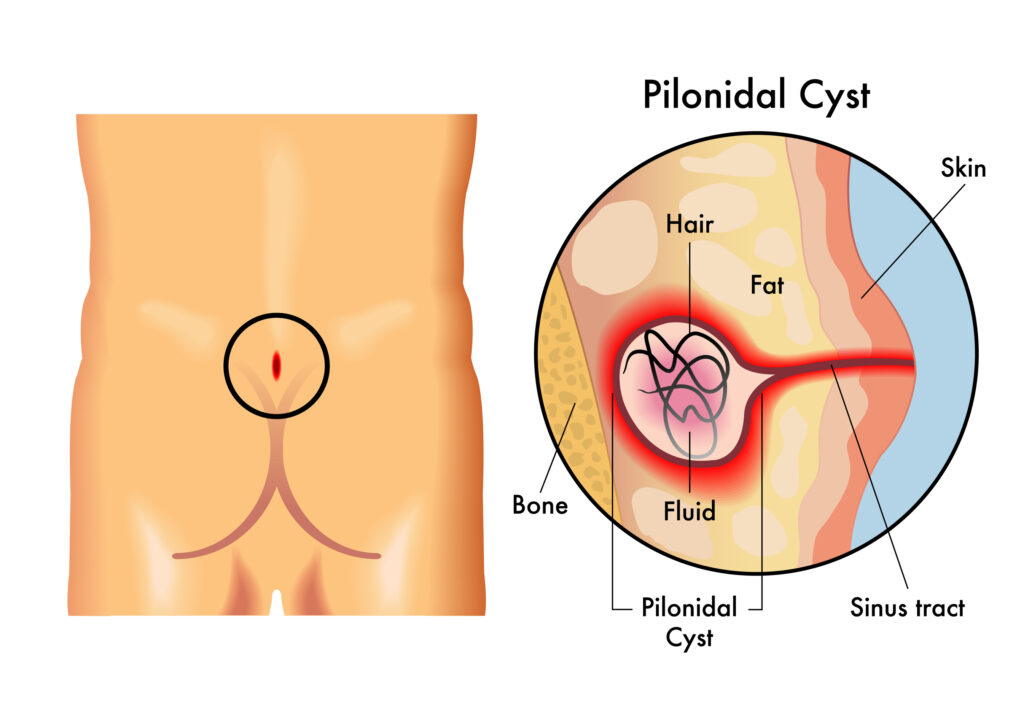
Small pits or holes visible in the midline of the natal cleft, the hallmark of pilonidal sinus disease.
Repeated cycles of acute infection, drainage, and incomplete healing are typical of undertreated or chronic pilonidal disease.
Loose hairs may be visible emerging from the pit openings or within the sinus on examination.
The diagnosis is made clinically in the vast majority of cases. The natal cleft is examined for pits, sinuses, abscesses and surrounding inflammation.
For complex, recurrent or atypical disease, MRI provides detailed mapping of sinus tracts and their relationship to surrounding structures, essential for surgical planning.
Swabs taken during drainage help identify causative organisms and guide antibiotic choice in cases with significant infection.
Pilonidal disease is frequently undertreated, with simple drainage leading to recurrent cycles of infection. A specialist assessment ensures the right procedure is chosen from the outset, minimising recurrence and the impact on your life.
Choosing the appropriate surgical approach based on disease extent and patient factors reduces the risk of recurrence significantly.
Acute abscesses are seen urgently. Definitive procedures are planned promptly to avoid months of recurrent infection.
Laser and video-assisted techniques for suitable cases offer rapid recovery and return to work.
The right surgical procedure can provide lasting resolution of pilonidal disease.
Anatomy
Pilonidal Cyst
Affects mostly
Simple drainage recurrence
Day case rate
Specialist opinion when it matters
Appointments typically within 3–5 working days.
Delivering high quality, patient-focused care
© 2025 West Midlands Surgical Centre. All rights reserved. · Privacy Policy · Terms & Conditions This website provides general information only and does not constitute medical advice. Always consult a qualified clinician.